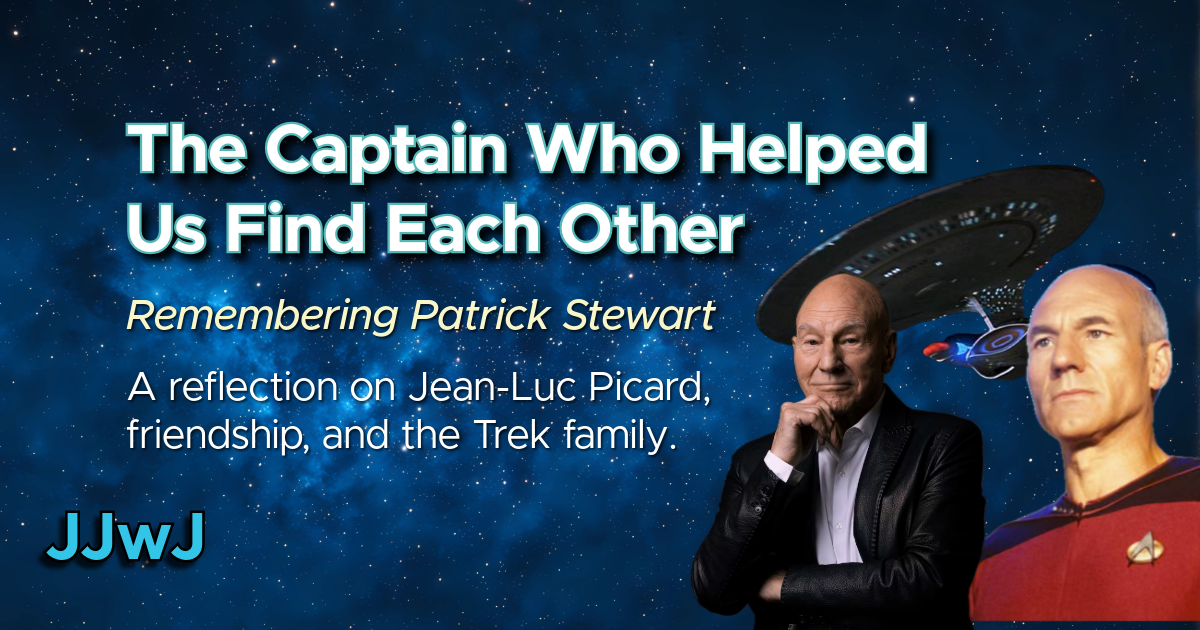
The Captain Who Helped Us Find Each Other
Patrick Stewart gave us more than Jean-Luc Picard. He helped generations of Star Trek fans find friendship, belonging, and a family among the stars. A personal reflection on the captain, the man, and the connections that live on through his work.

I was seventeen when I first met Jean-Luc Picard. I had no idea that nearly forty years later, I’d be sitting here trying to find the words to say goodbye to the man who brought him to life.
Back in 1987, I was mostly concerned with whether this new captain could possibly live up to James T. Kirk. There was a new Enterprise, an unfamiliar crew, and a rather serious-looking gentleman sitting in the center chair who seemed capable of making someone reconsider their entire existence with a single raised eyebrow.
And then there was that voice. Patrick Stewart could make the simplest instruction sound like the most important decision anyone had ever made. When Picard stood up to deliver one of those magnificent speeches, you paid attention. I certainly did, although at seventeen I’m fairly certain I understood considerably less of what he was saying than I thought I did.
By the time I went to college, Star Trek: The Next Generation had become something I wasn’t willing to leave behind. We recorded episodes on our VCRs and found time between classes, rehearsals, and studying to watch them together. If someone forgot to record an episode, we had a problem. If someone accidentally recorded over one, we had a situation that might require Starfleet mediation.
But we found ways to watch, and more importantly, we found people to watch with.
Those evenings weren’t just about what happened aboard the Enterprise-D. They were about sitting together, laughing at the same moments, debating Picard’s decisions, and occasionally discovering that a television show about exploring the galaxy had given us something surprisingly important to talk about.
We were young adults trying to figure out the world. I didn’t realize it then, but some of those conversations would stay with me long after college. Neither did I know that the stories we were sharing would eventually introduce me to people who would become dear friends.
And I certainly couldn’t have imagined how difficult it would be to say goodbye to Patrick Stewart.
His death has brought back memories of that seventeen-year-old version of me, the friends gathered around a VCR, and all the people who have found their way into my life because of Star Trek. When someone whose work has accompanied us for decades dies, the loss reaches into our own memories. We remember where we were when we first encountered that work, who shared it with us, and how differently we understand it now.
For generations of fans, Jean-Luc Picard became far more than a fictional captain. He was a leader, a teacher, a father figure, and sometimes the reassuring voice we wished we could hear when life became particularly complicated.
He wasn’t perfect. He could be stubborn, impatient, and occasionally make decisions that left the rest of us wondering what on Earth, or any other planet for that matter, he was thinking. But he listened, he questioned, and when he discovered he was wrong, he was capable of changing his mind.
At seventeen, I admired his confidence. I loved the way he could walk onto the bridge and somehow make everything feel as though it might turn out all right. At fifty-six, I appreciate something different. I understand more about the weight of responsibility, the difficulty of making decisions when there are no easy answers, and the courage it sometimes takes to admit that you don’t know what to do.
Patrick Stewart gave us a captain we could grow alongside, and one of the things I’ve come to appreciate most is how much humanity he allowed us to see beneath that uniform.
When I first watched “Family,” I understood that Picard had been through something terrible. He’d been assimilated by the Borg, forced to participate in the destruction of Starfleet ships, and returned to a life that could never be quite the same. But I don’t think I fully understood the weight of what he was carrying until I had a few more years of living behind me.
Watching him finally break down in front of his brother feels different now. I understand more about what it means to keep going when something has shaken you, and how difficult it can be to admit that you’re not all right. Stewart made that vulnerability feel real, and it’s one of the reasons Picard has stayed with me.
His years performing Shakespeare had given him an extraordinary command of language, but what made Picard so meaningful wasn’t simply the way he delivered a speech. It was the uncertainty, the grief, the occasional awkwardness, and the vulnerability of someone trying to live up to his own ideals.
I think that’s why so many of us felt we knew Jean-Luc Picard. We recognized something of ourselves in him, even if most of us weren’t responsible for a starship carrying more than a thousand people. And who among us wouldn’t have appreciated the chance to sit across from him with a cup of Earl Grey and ask for a little advice? I’d have brought coffee, naturally, but I think he would have forgiven me.
As the years passed, I came to admire something else. The man behind the captain seemed to understand that the influence of his work carried responsibilities of its own.
Patrick Stewart could have spent the rest of his life simply enjoying the admiration that came with playing Jean-Luc Picard. Instead, he used that attention to speak about things that were deeply personal to him, including the domestic violence he witnessed as a child. He became an advocate for survivors, supported efforts to address psychological trauma among veterans, and showed a wonderful affection for rescue dogs who needed someone willing to look beyond the stereotypes surrounding them.
I always loved seeing Stewart with a dog. There was something delightfully reassuring about watching the man who commanded the Enterprise become completely smitten with a four-legged creature who couldn’t have cared less about Starfleet regulations.
But beneath those moments of humor was something I genuinely admired. Stewart recognized that having a voice people listened to gave him an opportunity to help others be heard. The man who helped us imagine a future built on compassion was willing to do some of the uncomfortable work of practicing it in the present.
And when I think about that, I find myself returning to one of Picard’s most memorable moments.
In “The Measure of a Man,” Picard defends Data’s right to be recognized as an individual rather than treated as Starfleet property.
“Starfleet was founded to seek out new life. Well, there it sits!”
I’ve always loved that scene. Picard isn’t asking everyone to agree about something they don’t yet understand. He’s asking them to recognize the individual standing before them and consider what their decision says about themselves.
I wonder how many people have watched that episode and found something deeply personal in it. How many saw their own experiences reflected in Data’s struggle to be recognized, or found themselves questioning assumptions they’d never considered before.
That’s one of the things Star Trek has always done so beautifully. It gives us stories that stay with us, sometimes becoming more meaningful as our own lives change. And sometimes those stories lead us to one another.
This past August, I attended my first Star Trek convention in Las Vegas. After decades of watching the Enterprise explore the galaxy, I found myself surrounded by thousands of people who had carried those same stories through their own lives.
Some were friends I’d known for years but had never met in person. We’d talked through microphones, laughed across time zones, and shared pieces of our lives through screens. And suddenly, there we were, standing together, hugging, laughing, and discovering that the friendships were every bit as real in person.
I remember meeting my podcast co-host Mike at preregistration. After all the conversations we’d shared, there was something wonderful about finally being in the same place. We weren’t just voices coming through headphones anymore.
My wife was having a marvelous time with the cosplayers, including a particularly memorable encounter with a Mugato. There were costumes everywhere, familiar faces from the shows we’d loved, and people stopping to admire one another’s creativity.
But what I remember most is the kindness. People making room for one another, sharing stories, welcoming strangers into conversations, and celebrating the simple joy of being together. There was a feeling of belonging that I hadn’t entirely expected, even after all these years of loving Star Trek.
I remember looking around and realizing that I wasn’t simply attending a convention. I was spending time with people who had become part of my life because, somewhere along the way, we’d all found our way to Star Trek.
And I thought about that seventeen-year-old girl sitting in front of a television in 1987. She had absolutely no idea what was waiting for her.
I don’t want to suggest that Patrick Stewart created that community by himself. Star Trek has always been the work of countless people, both those who bring the stories to life and those who carry them into the world. But Stewart helped give us a captain whose example shaped the kind of community many of us hoped to find.
One where curiosity matters, differences can be celebrated, and we can disagree without forgetting one another’s humanity.
Now, I know Trek fandom doesn’t always manage that last part. We’re human, after all, and occasionally a disagreement about a starship can escalate into something resembling an interstellar diplomatic incident.
But I’ve also seen what happens when we get it right. I’ve watched fans support one another through illness, loss, and difficult changes. I’ve seen people celebrate someone else’s creativity as enthusiastically as their own, encourage a nervous newcomer, and make room for someone who wasn’t sure where they belonged.
I’ve watched strangers become friends and friends become family.
Patrick Stewart understood how deeply these stories mattered to people. Over the years, he heard from fans who had found comfort, encouragement, and a sense of connection through Jean-Luc Picard. I wonder what it must have been like to discover that a character you’d portrayed had become part of someone else’s memories, relationships, and understanding of the world. I hope those conversations brought him as much joy as his work brought us.
And while Picard may be the character I will always associate most closely with Stewart, his creative life was so much larger. His devotion to Shakespeare, his extraordinary work on stage, and his portrayal of Professor Charles Xavier gave audiences other ways to discover his talent. He could bring enormous dignity to a performance and then turn around and be wonderfully ridiculous.
I especially loved seeing that playful side of him with Ian McKellen. Two accomplished actors who could move from Shakespeare to complete silliness and look as though they were having the time of their lives. Those moments mattered, too. They reminded us that beyond the characters, the causes, and the distinguished voice was a man who loved his craft, valued friendship, and knew how to laugh.
As I’ve watched people remember Patrick Stewart this week, I’ve been thinking about all the different ways his work entered our lives. Some discovered him through Shakespeare, others through X-Men, and so many of us through Jean-Luc Picard. Each of us carries something different from those performances, and perhaps that’s why his loss feels so personal, even to those of us who never knew him.
But there’s something about the stories he leaves behind that brings me comfort.
Somewhere, someone is going to meet Jean-Luc Picard for the very first time. Maybe it’ll be a teenager watching with a parent, a college student looking for something to watch between classes, or someone who has never considered themselves a science fiction fan.
They’ll hear that familiar voice, watch the Enterprise-D glide through the stars, and discover a captain who challenges them to think, to question, and to look beyond what they believe they know.
And if they’re lucky, they’ll find someone to share those stories with. Someone to laugh with, debate with, and talk to long after the episode ends. Perhaps they’ll find their own Trek family, just as so many of us have.
I think about the seventeen-year-old who first watched Picard take command of the Enterprise-D, and I wish I could tell her that one day those stories would lead her to friendships she couldn’t possibly imagine. That she’d carry them from college dorm rooms to a convention in Las Vegas, discovering along the way that the people she met because of Star Trek would become just as important as the stories themselves.
I never had the opportunity to meet Patrick Stewart. I would have loved to thank him, ask him about Shakespeare, and probably take up far too much of his time with questions about Picard. But mostly, I would have wanted him to know what those stories made possible.
My heart goes out to his family, his friends, his colleagues, and everyone who knew and loved him. Their loss is far more personal than the one we feel from a distance, and I hope there’s comfort in knowing how much his work meant to people around the world.
Thank you, Patrick, for the humanity you brought to Jean-Luc Picard, the compassion you showed beyond the screen, and the people your work helped bring into my life.
We’ll take good care of one another.
And we’ll keep making room for the next generation.
Engage.
✨Remember, Be Kind. Do More Good. We Got This.
💫Until next time, lovelies, keep jibber jabbering about the stories and ideas that move you.