The Future Walter Koenig Helped Carry Forward
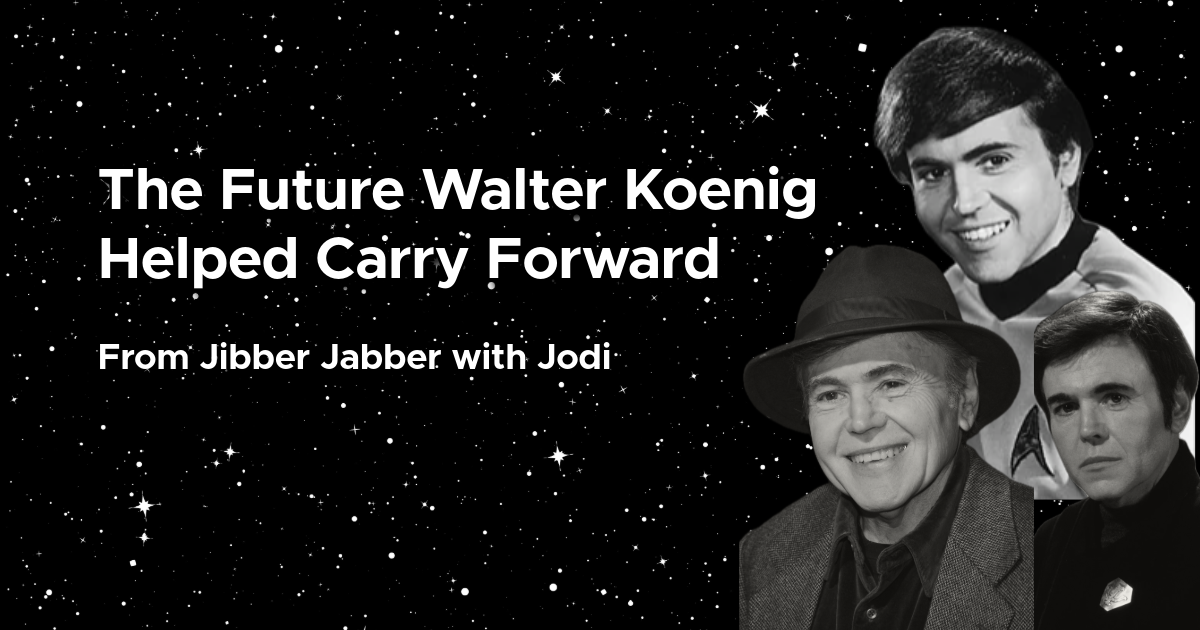
Walter Koenig gave us Pavel Chekov, but his legacy reaches far beyond the Enterprise. A personal reflection on the actor, the friendships he built, the kindness he shared with fans, and the future he helped us imagine.

I’ve been thinking about the bridge of the original Enterprise.
Not the technology, although I will always have a particular affection for those colorful buttons, blinking lights, and the wonderful background hum that made the ship feel alive. I’ve been thinking about the people sitting at those stations and what it meant to see them there.
In the 1960s, when much of the world was divided by suspicion, fear, and the possibility of nuclear war, Star Trek imagined something different. It placed people from nations that were adversaries in the same room, working together toward something larger than the disagreements that had once separated them. And sitting at the navigation station was a young Russian officer named Pavel Chekov.
Walter Koenig joined Star Trek during its second season, bringing youthful enthusiasm, humor, and an unmistakable personality to the Enterprise crew. Chekov could be proud, occasionally ridiculous, and wonderfully certain that just about everything worthwhile had originated in Russia. He was also capable, courageous, and fiercely loyal to the people serving beside him. I loved that about the character. He wasn’t there simply to represent an idea. He was a person within that imagined future, complete with his own quirks, ambitions, and occasionally questionable assertions about Russian history.
And the idea behind his presence mattered. Here was a young Russian man serving alongside Americans, a Japanese helmsman, a Black communications officer, and a Vulcan science officer. The original series didn’t always get everything right, and its vision was shaped by the limitations of its time. But it dared to suggest that the world we knew didn’t have to remain the world we accepted. Walter helped give that possibility a face.
When I learned of Walter’s passing on October 25, at the age of ninety, I found myself thinking about more than the character he played. Here was an actor who had joined a television series that lasted only three seasons, never knowing that the work would become part of so many people’s lives. Decades later, he was still meeting the people who had found friendship, hope, and belonging in the stories he helped tell. I wonder whether anyone could have anticipated just how far those stories would travel.
Walter spent decades appearing at conventions, meeting fans, answering questions, and participating in a community that grew far beyond anything the original production could have imagined. Following his death, his longtime representative, Zachery McGinnis, remembered Walter’s kindness, wit, appreciation for fans, and understanding of what Star Trek meant to the people who loved it.
That last part has stayed with me. He understood what Star Trek meant to people.
I think there’s something important in those words, because the meaning of a story doesn’t belong exclusively to the people who create it. Once that story reaches an audience, it begins becoming part of other lives. Someone finds courage in a character. Someone else discovers a sense of belonging. A child sees a future that looks more welcoming than the world around them. And sometimes a television series becomes the reason two people who would otherwise never have met find themselves talking as though they’ve been friends for years.
I’ve experienced enough of the Star Trek community to know those connections are real. The friendships, the generosity, and the excitement of discovering people who understand why these stories matter. They aren’t imaginary simply because the universe that brought us together is fictional.
I never had the opportunity to meet Walter, so I can’t offer a personal story about an interaction we shared. But the remembrances from people who knew him offer glimpses of someone who appreciated the relationships that grew from his work. And those relationships were only one part of a much larger life.
Walter was never only Pavel Chekov. He continued working as an actor, writer, and teacher, exploring different kinds of stories and characters. His portrayal of Alfred Bester in Babylon 5 remains one of my favorite examples of his range. Anyone familiar with Bester knows that Walter could make an audience deeply uncomfortable with little more than a smile and the suggestion that he knew something you didn’t. Quite a departure from the enthusiastic young navigator who was always ready to remind everyone of Russia’s many contributions to civilization.
I also appreciate that Walter continued pursuing creative challenges rather than allowing his most recognizable role to define everything that came afterward. There was so much more to his creative life than a Starfleet uniform, and there was so much more to his personal life than his creative work.
George Takei’s remembrance of Walter brought that home for me. The two men met on the Enterprise bridge in the 1960s and remained friends for nearly six decades. When George married Brad Altman in 2008, Walter stood beside them as best man. I keep coming back to that image. Not two actors appearing together at a convention or returning for another Star Trek production, but two friends sharing one of life’s most meaningful occasions.
We often talk about the original cast as though they exist together in a permanent moment from television history. In our memories, they’re still on that bridge, looking toward the viewscreen, preparing to encounter whatever waits beyond the next star. But outside those stories, they were living entire lives. They built friendships and families, pursued other interests, faced disappointments, experienced loss, and grew older.
What stays with me about George’s remembrance isn’t simply the length of their friendship, but the affection behind it. George knew Walter beyond the Enterprise, beyond the conventions, and beyond the character generations of fans came to love. He remembered a thoughtful man, a writer, a teacher, and a loyal friend. Others remembered Walter’s wit, kindness, and appreciation for the people who continued to celebrate his work. Those are the qualities I find myself thinking about now, because they speak to something no list of performances or accomplishments could fully capture.
This year, Star Trek celebrated its sixtieth anniversary. Sixty years since audiences first heard those opening words and were invited to imagine a future that looked different from the world outside their windows. Walter helped shape the Enterprise crew that generations of fans came to know and love, and he lived long enough to see that small television series become an extraordinary cultural legacy.
But what moves me most isn’t the size of that legacy. It’s the thought of Walter continuing to meet fans decades after Chekov first appeared on television, listening as they shared what Star Trek had meant to them. He must have heard some of the same questions countless times, and probably a few stories more than once. Yet the remembrances of his kindness suggest that he continued to recognize the importance of those encounters. What began as a role in a television series became a connection that continued through much of his life, shaped not only by what he gave audiences but by the memories and gratitude they shared with him.
I think that’s a lovely thing to be remembered for.
Through all of it, Walter was living his own life, too. He was a creative person with his own interests and ambitions, a friend who showed up for the people he loved, and someone who could make us laugh as Chekov, make us wonderfully uncomfortable as Bester, and leave an entirely different impression on the people who met him away from the screen.
I started this essay thinking about the bridge of the Enterprise, and I suppose that’s where I’ll always picture Chekov. Sitting at navigation, ready with an answer, occasionally convinced that Russia deserved credit for something nobody else had ever associated with it. There’s a warmth in those memories, the kind that comes from spending a lifetime returning to characters who have become wonderfully familiar.
But when I think about Walter Koenig, I want to remember more than the young man at that station. I want to remember the actor who kept creating, the friendships that lasted long after the cameras stopped rolling, and the kindness people experienced when they had the chance to meet him.
I wish I’d had that opportunity. Not because I needed another autograph or photograph, although I certainly wouldn’t have turned either one down. I would have liked the chance to say thank you and perhaps hear one of those stories he’d probably told a hundred times before. Knowing me, I would have had a question or two. Possibly several more than two.
I didn’t get that chance, but I’m grateful for what he shared with all of us.
Thank you, Walter, for giving us Chekov, for the laughter and the stories, and for continuing to make room in your life for the people who found something meaningful in your work.
You helped us imagine a future where people could find common ground, where differences didn’t have to keep us apart, and where kindness and curiosity could lead us somewhere better. From the memories being shared by those who knew you, it sounds like you understood that those things mattered just as much when the cameras weren’t rolling.
I think that’s a wonderful way to be remembered.
You’ll be missed, Walter.
✨Remember, Be Kind. Do More Good. We Got This.
💫Until next time, lovelies, keep jibber jabbering about the stories and ideas that move you.