Raffi Has a Starship. I Have Questions.
Captain Raffi Musiker has her own starship, Janeway knows her worth, and Starfleet has an AI that predicts danger. My thoughts on Star Trek: Zero Point #1, its unexpected crew, and the questions I can’t stop asking.

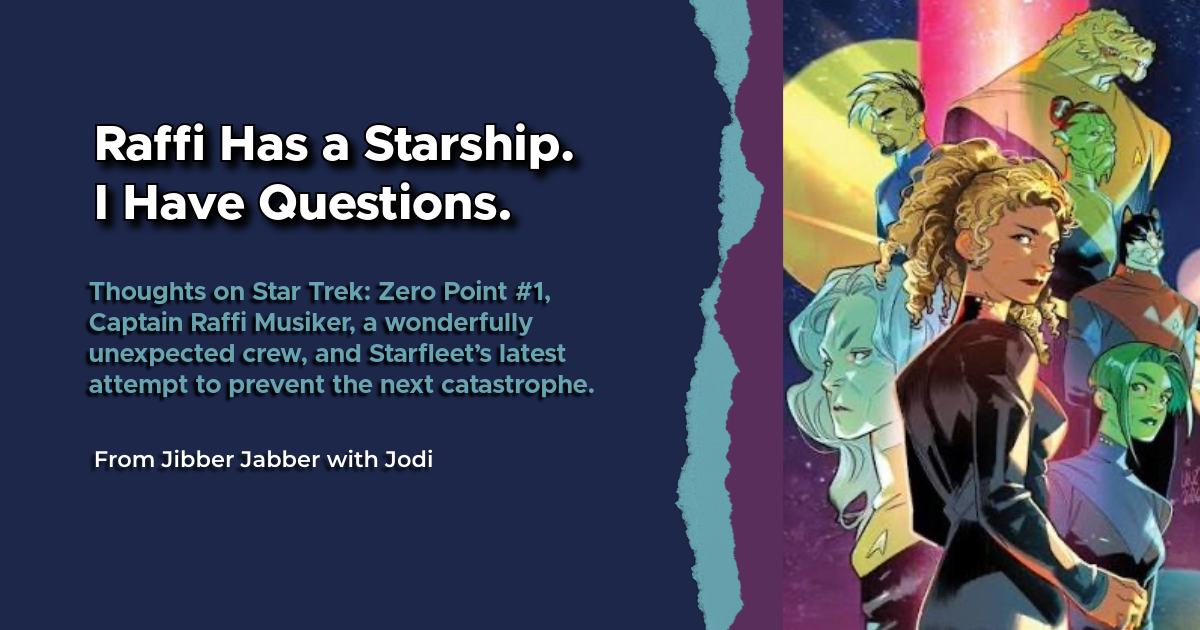
Some thoughts on Star Trek: Zero Point #1, Captain Raffi Musiker, a wonderfully unexpected crew, and Starfleet’s latest attempt to prevent the next catastrophe.
⚠️ Spoiler warning for Star Trek: Zero Point #1 and Star Trek #1 (2026).
There are certain things Star Trek can do that will pretty much guarantee my attention, and putting Raffi Musiker in command of her own starship is definitely one of them. I’ve been wondering where Raffi’s story might go since Star Trek: Picard ended, so when I heard she was finally getting the captain’s chair in Star Trek: Zero Point, I was already interested.
Then I opened the first issue and discovered that Admiral Kathryn Janeway was the person offering her that command. Oh, now we’re talking.
First of all, I love seeing these two women together. Raffi Musiker and Kathryn Janeway are not exactly known for sitting quietly and accepting that Starfleet always knows best. I suspect they could have a rather entertaining conversation about some of the decisions made by Starfleet Command over the years, preferably with coffee involved. Janeway can bring the coffee. Raffi can bring the receipts.
But what really got me was Janeway acknowledging that Starfleet hasn’t always listened to Raffi, even when she was right. FINALLY! Someone in a position of authority is willing to recognize what we’ve watched Raffi struggle with for years, and it happens to be Kathryn Janeway. I may have enjoyed that moment a completely unreasonable amount.
And honestly, I think Janeway is exactly the kind of person who would appreciate Raffi. She’s never been particularly interested in following orders simply because someone with more pips thinks they know better, and she understands that an officer who asks difficult questions isn’t necessarily an officer who can’t be trusted. Sometimes they’re the person you should have been listening to all along.
Of course, Janeway isn’t there simply to make Raffi feel appreciated. She’s offering her command of the U.S.S. Endeavour and a rather unusual assignment. Starfleet wants to get better at identifying threats before they turn into disasters, and it’s developed an artificial intelligence named Sybil to help make that happen.
Now, I can understand why Starfleet would want to be a little more proactive after everything the Federation has been through. But I also find it interesting that the same organization that spent so much time dismissing Raffi’s warnings is suddenly prepared to place enormous confidence in a machine that predicts danger. Apparently, when Raffi tells you something terrible might happen, we need several meetings and a committee. Give that responsibility to a positronic brain, though, and here’s your starship.
I’m being a little unfair, perhaps, but you see where I’m going with this. And I can’t help wondering what this particular mission is going to mean for Raffi. She’s spent so much time dealing with the consequences of people not listening that the opportunity to prevent another catastrophe must be enormously appealing. But there’s a difference between wanting to protect people and feeling like you personally have to make sure nothing ever goes wrong again. I suspect that distinction could become rather important as she settles into command.
Now, before we get too deep into Starfleet’s latest classified adventure, can we talk about Seven and Raffi for a moment?
Because just last month, Star Trek #1 gave us the rather wonderful news that these two women are married, and I am still enjoying that development immensely. Zero Point gives us another glimpse of what their lives look like now that Seven commands the Enterprise-G and Raffi has the Endeavour.
Two captains. Two starships. One marriage.
I’m delighted for them, although I have some questions about how this is supposed to work when both women are off exploring the galaxy. Does Starfleet have a special scheduling department for married captains? Is there a shared calendar somewhere that requires an admiral’s approval? Because I would very much like to know how they’re managing date night.
Joking aside, I love that both Seven and Raffi get to pursue their own ambitions while building a life together. I still want more opportunities to see their relationship develop, especially since we didn’t get nearly enough of that onscreen. But seeing these two women married and commanding their own starships is something I never would have taken for granted when I first started watching Star Trek. The sapphic space ladies are doing rather well for themselves, and I’m here for it.
And speaking of unexpected developments, can we appreciate the crew Charlie Jane Anders has assembled for the Endeavour?
First, D’Vana Tendi as Raffi’s first officer. Now there’s a combination I didn’t know I needed, but I’m already interested in what happens when these two women start figuring out how to work together.
I’ve always loved Tendi’s enthusiasm on Lower Decks, but she’s never been someone who should be underestimated simply because she’s cheerful. She’s intelligent, resourceful, and perfectly capable of standing her ground when something doesn’t seem right. In Zero Point, she’s not particularly comfortable with the amount of trust Starfleet is placing in Sybil, which seems like a perfectly reasonable concern.
I rather like the idea of Raffi having a first officer who’s willing to ask difficult questions, especially when Raffi herself can become so focused on what she believes needs to happen. I don’t want Tendi to simply be the person who agrees with every decision her captain makes, and I don’t think Raffi would particularly benefit from that either. Give me two capable officers with different instincts who have to figure out how to trust one another, even when they disagree.
And then there’s Commander Saavik in engineering. On Raffi’s ship. Alongside Tendi.
I’m sorry, but I need a moment to appreciate this particular combination of Star Trek characters. I don’t think that’s a crew I would have come up with on my own, and I love that the comics can bring together characters from different corners of the franchise in ways that feel wonderfully unexpected. I also hope Saavik gets plenty to do as the series continues. She’s a character with her own history and perspective, and I’d love to see what she brings to this crew beyond the immediate excitement of recognizing her.
Part of the fun of seeing these characters together is getting to experience them through a different visual interpretation of Star Trek. Isaac Sánchez González gives the familiar faces enough detail to make them immediately recognizable without making the artwork feel like a collection of television screenshots. I appreciate that the comic has its own visual personality, especially when we get to some of the more unusual imagery surrounding the Endeavour’s first mission. I won’t spoil those moments because they’re worth seeing for yourself, but they reminded me how much fun Star Trek can have when its imagination isn’t negotiating with a television production budget.
And speaking of imagination, let’s talk about the people at Starfleet who apparently looked at its entire history with artificial intelligence and decided it was time to try something new. Meet Sybil.
Starfleet has created an artificial intelligence designed to identify threats before they become catastrophes, and they’ve apparently decided that the best approach is to combine some very familiar pieces of Star Trek’s technological history. Sybil’s positronic brain is based on Dr. Noonien Soong’s schematics, her programming draws on Voyager’s Emergency Medical Hologram, and her holographic appearance looks remarkably like Uhura from The Original Series.
That’s quite a collection of Star Trek history wrapped up in one artificial intelligence. I’m not sure whether I’m supposed to feel reassured or start looking for the nearest emergency shutdown procedure.
The Soong connection immediately brings Data to mind, and the EMH connection makes me think about how far Voyager’s Doctor developed beyond the program he was originally designed to be. Both characters gave us some wonderful stories about identity, individuality, and what happens when artificial life becomes something more than its creators anticipated. Which makes me wonder whether Starfleet has considered that possibility with Sybil. Is she simply an extraordinarily advanced tool, or could she eventually develop an identity and sense of self that nobody involved in this project expected? And if that happens, will Starfleet be prepared to recognize it?
I’m also fascinated by the decision to give Sybil an appearance that resembles Uhura. Maybe it’s simply a visual connection to Star Trek’s history, but I can’t help wondering whether it’s meant to inspire trust. Uhura represents communication, cooperation, and the kind of connection that has always been central to Starfleet’s ideals. That’s an interesting face to give an intelligence whose primary purpose is identifying potential danger.
And then there’s the name. Sybil. They named an extraordinarily powerful, seemingly all-knowing positronic brain Sybil, and I have to admit my Gen X brain immediately went somewhere other than ancient prophecy.
Now, I understand the connection to the ancient sibyls. It’s actually a clever choice for an intelligence designed to predict what might happen next. But I also grew up with the 1976 television movie Sybil being part of the pop-cultural conversation, so naturally my brain made that connection first. And then I started wondering whether Starfleet had managed to create an artificial intelligence with so many different programs and personalities contributing to its development that Sybil might eventually start having arguments with herself. Imagine asking your ship’s highly advanced predictive intelligence a simple question and discovering that she’s having an argument with herself about which answer to give you. Meanwhile, the rest of the bridge crew is standing there wondering whether anyone should interrupt.
I realize that’s probably not where Charlie Jane Anders is taking this story, but you cannot introduce an all-knowing positronic brain named Sybil and expect my Gen X imagination not to wander off and entertain itself for a few minutes.
But here’s what I keep coming back to with Sybil. Just because Starfleet has created something that can predict potential threats, does that mean it should automatically trust those predictions when deciding what to do next?
I understand the appeal. After everything the Federation has experienced, who wouldn’t want to prevent the next catastrophe rather than spend another season dealing with the aftermath? But predicting something might happen isn’t the same as knowing it will happen, and identifying a possible danger doesn’t automatically tell you what the right response should be.
We’re having versions of that conversation in our own world as artificial intelligence becomes part of more decisions about how we work, create, and solve problems. I’m interested in what the technology can make possible, but I’m equally interested in who gets to question its conclusions and who remains responsible when those conclusions influence real decisions. Star Trek has always been good at taking ideas like that, putting them aboard a starship, and seeing what happens when things become considerably more complicated than anyone anticipated.
And Zero Point doesn’t waste much time doing exactly that.
Without giving away the details of the Endeavour’s first mission, I will say that Raffi and Tendi approach some of its challenges from noticeably different perspectives. Raffi is determined to complete the assignment, while Tendi seems more willing to question whether everyone should be placing quite so much confidence in Sybil’s information.
I found myself appreciating both of their positions. Raffi knows what happens when legitimate warnings are ignored, but Tendi also understands that information should be questioned, particularly when people’s lives may depend on getting it right. Neither of them is being unreasonable, and I think that’s what could make their working relationship so interesting.
I’m especially curious to see how Raffi handles having someone challenge her decisions now that she’s the person sitting in the captain’s chair. She’s spent plenty of time being the one questioning Starfleet’s judgment, and there’s something rather delicious about the possibility that she may now have to learn how it feels from the other side of the conversation.
I also hope the story resists making Sybil either an obvious villain or an uncomplicated technological miracle. There’s so much more interesting territory between those possibilities, especially when we’re talking about an artificial intelligence whose origins connect to Data and the Doctor. I’d love to see the comic explore what Sybil might become, as well as what happens when Starfleet starts depending on her predictions.
And while we’re discussing things I’m curious about, is Raffi’s captain’s phrase going to be “Onward”? Because I really rather like that. It’s simple, confident, and feels appropriate for someone who has spent so much of her life dealing with the past. I like the idea of Raffi choosing a word that looks toward whatever comes next without pretending that everything she’s experienced has somehow disappeared. I’m not prepared to declare it her official phrase after one issue, but I’m putting my approval on the record.
I’ve finished the first issue with plenty of questions, a few suspicions, and an increasingly long list of things I want Charlie Jane Anders to explore. I’d also appreciate a little more Seven and Raffi together, because I refuse to believe Starfleet can’t arrange a date night for two captains somewhere in the galaxy.
But mostly, I’m just happy to see Raffi getting this opportunity. I’ve wanted more of her story since Picard ended, and now she’s got a starship, a crew I never would have thought to put together, and what looks like a very interesting adventure ahead of her.
Onward, Captain Raffi. You’ve definitely got my attention.
✨Remember, Be Kind. Do More Good. We Got This.
💫Until next time, lovelies, keep jibber jabbering about the stories and ideas that move you.