More Than a Timeline
Star Trek: Timelines offers far more than a chronology of events. I explore the remarkable reference book, the passion of its authors, and how sixty years of storytelling remain grounded in the enduring ideas at the heart of Star Trek.

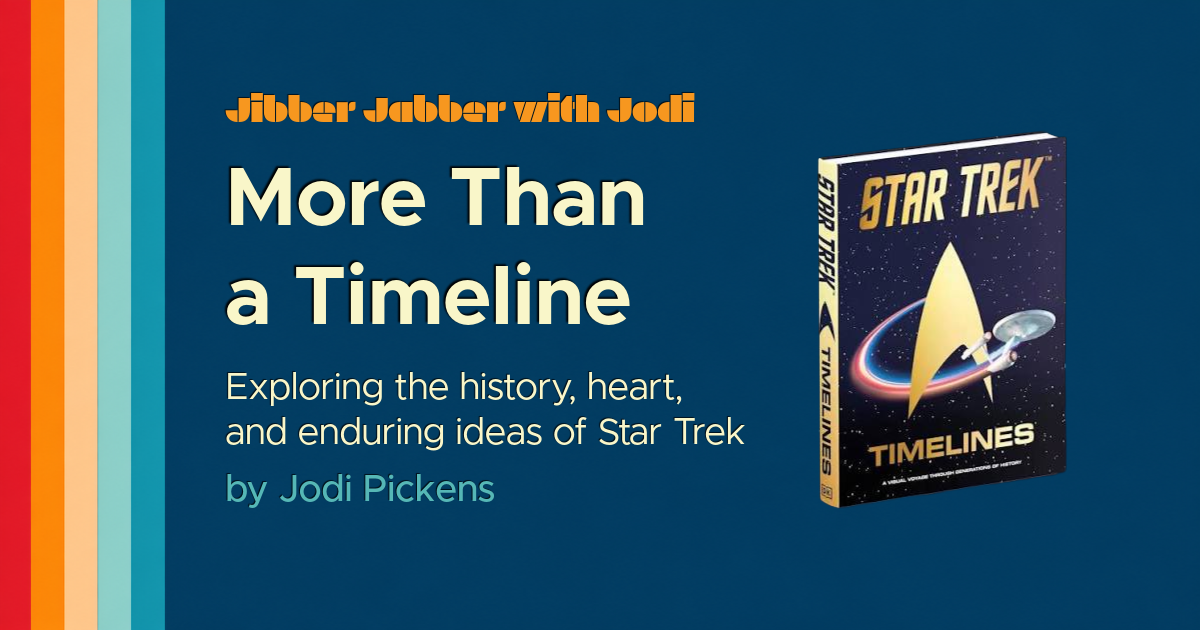
Exploring the history, heart, and enduring ideas of Star Trek
I’ve always thought that anyone volunteering to organize the entire history of Star Trek deserves a great deal of respect, a substantial supply of coffee, and possibly access to a temporal mechanics specialist.
Think about what we’re asking here. Sixty years of storytelling spread across television series, films, different centuries, alternate realities, and enough time travel to make even the most dedicated Starfleet historian question a few life choices. There are events that haven’t happened yet, events that happened more than once, and events that technically never happened at all. And somehow, someone has to make sense of it.
Naturally, I was curious to see how the authors of Star Trek: Timelines would approach something so wonderfully complicated. What I discovered was a book that offers considerably more than an explanation of what happened when.
One of my favorite things about Timelines is how easily you can lose yourself in it. You might open it looking for a particular event, only to find yourself studying a photograph from an episode you haven’t watched in years. The photographs from beloved episodes and films can bring entire stories rushing back, along with the characters, conversations, and moments that made them memorable. Of course, this creates the entirely predictable problem of deciding you need to watch an episode again. For research purposes, obviously.
A few pages later, you’re immersed in one of the two-page spreads devoted to significant characters, starships, or species, and whatever you originally intended to look up will simply have to wait. The freedom to wander through the book without losing your bearings is a testament to its design and layout. An enormous amount of information is presented in a way that feels inviting rather than overwhelming. Even the complexities of the Mirror Universe and all those delightfully complicated timey-wimey shenanigans are given their place without leaving you wishing you’d paid more attention in temporal mechanics class.
There’s something particularly interesting about seeing so much of Star Trek’s history gathered together. Despite the decades that separate the television series and films, and the centuries that separate the stories themselves, the values at the heart of Trek remain remarkably consistent. Kate Mulgrew speaks to those enduring values in the book’s foreword when she writes:
“It is truly a handbook laying out that which is best within all of us: our capacity to serve one another, to fight for what is right and good, to celebrate our differences, and to resist the instinct to jump ship when, in fact, that ship is all we know of humanity.”
I love her choice of the word handbook. As you explore page after page of historical facts and details, you can see just how firmly Star Trek remains grounded in science, exploration, community, friendship, and hope.
The technology evolves, our understanding of the galaxy expands, and generations of characters face challenges unique to their circumstances. Yet scientific curiosity continues to challenge assumptions, exploration creates opportunities for understanding, and friendships develop between people who might once have considered one another enemies. Even when the Federation struggles to live up to its own ideals, the possibility of a better future remains worth pursuing.
The authors haven’t needed to explain what Star Trek stands for on every page. The history they’ve assembled speaks for itself.
I had the pleasure of interviewing the authors for the CloneStar Podcast, and one of my favorite things about that conversation was simply being in the company of people who were so genuinely passionate about Trek. As a fan, there’s something wonderfully familiar about sharing that enthusiasm with others, particularly when everyone understands the joy of getting caught up in the smallest details of a fictional universe.
Having experienced their passion firsthand, I find myself appreciating the finished book even more. Behind every page are countless decisions about what to include, how to present it, and how to make six decades of storytelling accessible to readers. The time, dedication, and attention required to accomplish that are impressive, but what comes through most clearly for me is the heart that went into it.
I have no hesitation in saying that Star Trek: Timelines deserves a place on our bookshelves alongside the collective reference works of Michael and Denise Okuda. I can easily imagine fans reaching for this book decades from now to settle a friendly debate, satisfy their curiosity about a particular piece of Trek history, or simply spend an afternoon wandering through a universe they love.
So here’s a huge bravo to the authors of Star Trek: Timelines. You’ve given us a beautifully designed, meticulously researched, and thoroughly enjoyable resource that celebrates sixty years of Star Trek while allowing us to appreciate the threads that connect its stories.
There is a phrase we often use on the CloneStar Podcast, and I can’t think of a more fitting description of what you’ve accomplished here.
Made by fans, for fans.
Add It to Your Bookshelf
Ready to do a little exploring of your own? You can purchase Star Trek: Timelines through my Bookshop.org affiliate link. Just be prepared for a little timey-wimey wandering through Star Trek history.
Affiliate disclosure: I earn a commission if you purchase through this link, at no additional cost to you. Your purchase also helps support independent bookstores. Thank you for supporting Jibber Jabber with Jodi!
✨Remember, Be Kind. Do More Good. We Got This.
💫Until next time, lovelies, keep jibber jabbering about the stories and ideas that move you.